Incident Correlation Engine

Thousands of signals.
One correlated incident.

Nova's Correlation Engine uses AI to analyze alerts from every monitoring source in real time, automatically grouping related signals into a single actionable incident. No more alert storms, no more duplicate tickets, no more wasted triage cycles.

Start Free Trial Watch Demo
app.novaaiops.com · Incident Correlation Engine
● LIVE
Nova AI Incident Correlation Engine
94%
Noise reduction
<30s
Correlation time
Cross-signal
Analysis across all sources
0
False groups
Multi-Source Signal Fusion

Metrics, logs, traces, and events: fused into one incident graph

When a Kubernetes pod crashes, the correlation engine simultaneously ingests the OOMKill event, error log spikes, failed health checks, and upstream latency anomalies. Instead of four separate tickets landing on four different engineers, Nova fuses them into a single incident with full causal context attached. Your team sees one notification with everything they need.

  • Topology-aware grouping: alerts correlated using your live service dependency graph, not just timestamp proximity
  • 464-source ingestion: Datadog, CloudWatch, Prometheus, PagerDuty, Sentry, and hundreds more feed into the same engine
  • Causal ordering: every grouped alert is sequenced by when it actually fired, showing the cascade path from root to symptom
app.novaaiops.com · Signal Fusion
Multi-source signal fusion
Temporal & Semantic Clustering

Not just "same time": same root cause

Basic correlation tools group alerts that fire within the same window. Nova goes deeper: it analyzes semantic similarity between alert messages, checks service ownership overlaps, and applies ML models trained on your incident history to determine whether alerts are truly related. A CPU spike on service A and a timeout on service B only get grouped if there's an actual dependency chain connecting them.

  • Embedding-based similarity: alert descriptions vectorized and clustered using transformer models, catching related alerts with different wording
  • Adaptive time windows: correlation windows expand or contract based on your infrastructure's typical propagation speed
  • Continuous learning: every time an engineer merges or splits incidents manually, the model retrains to improve future accuracy
app.novaaiops.com · Semantic Clustering
Temporal and semantic clustering
Real-Time Correlation Dashboard

Watch incidents form in real time as alerts stream in

The correlation dashboard visualizes the grouping process live. As new alerts arrive, you see them snap into existing incident clusters or seed new ones. Each cluster shows its constituent signals, confidence score, and suggested severity. When correlation confidence drops below your threshold, Nova flags it for human review instead of auto-grouping, keeping false merges at zero.

  • Live cluster visualization: watch alert nodes connect to incident groups in a force-directed graph updated every second
  • Confidence scoring: every correlation displays a 0-100 confidence score with explanation of why alerts were grouped
  • Manual override controls: split or merge groups with one click; overrides feed back into the ML model immediately
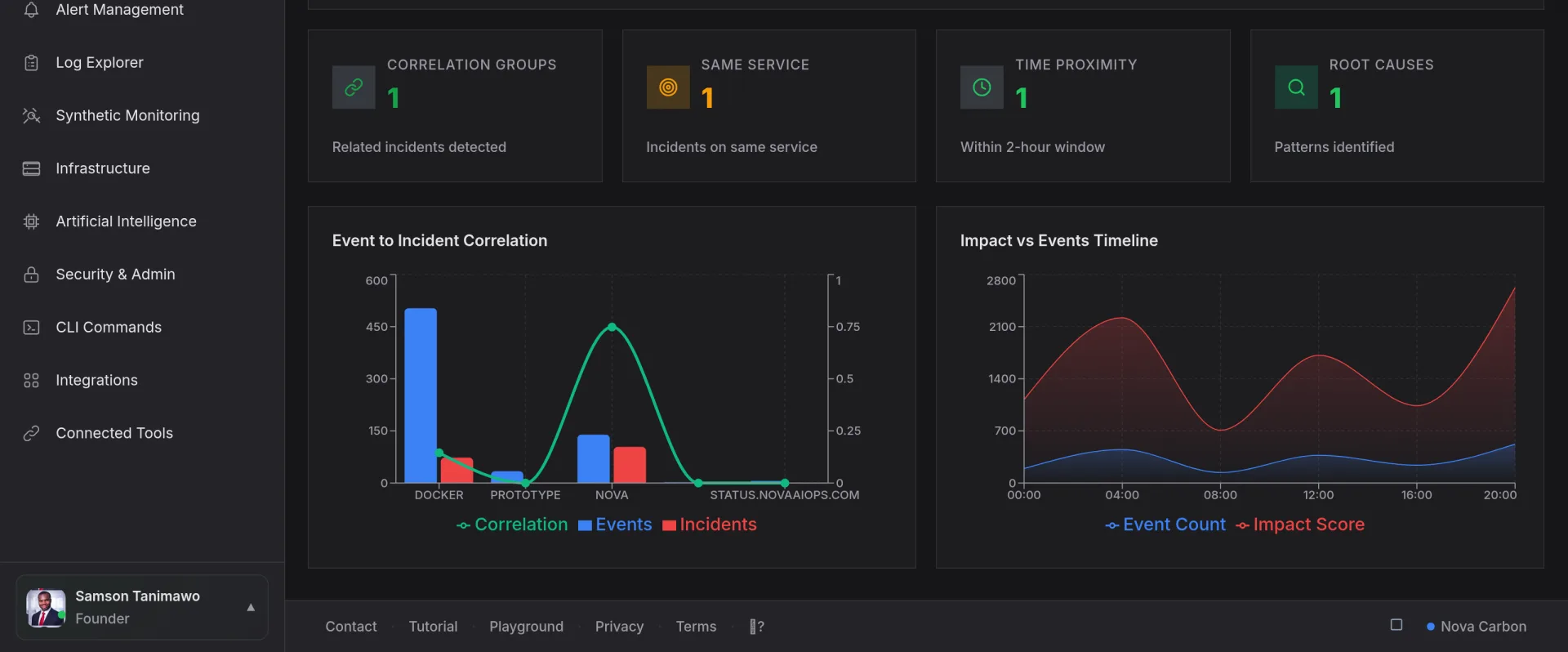
app.novaaiops.com · Correlation Dashboard
Real-time correlation dashboard

Stop drowning in duplicate alerts

See how Nova correlates thousands of signals into actionable incidents in under 30 seconds with zero false groups.

Start Free Trial Request a Demo