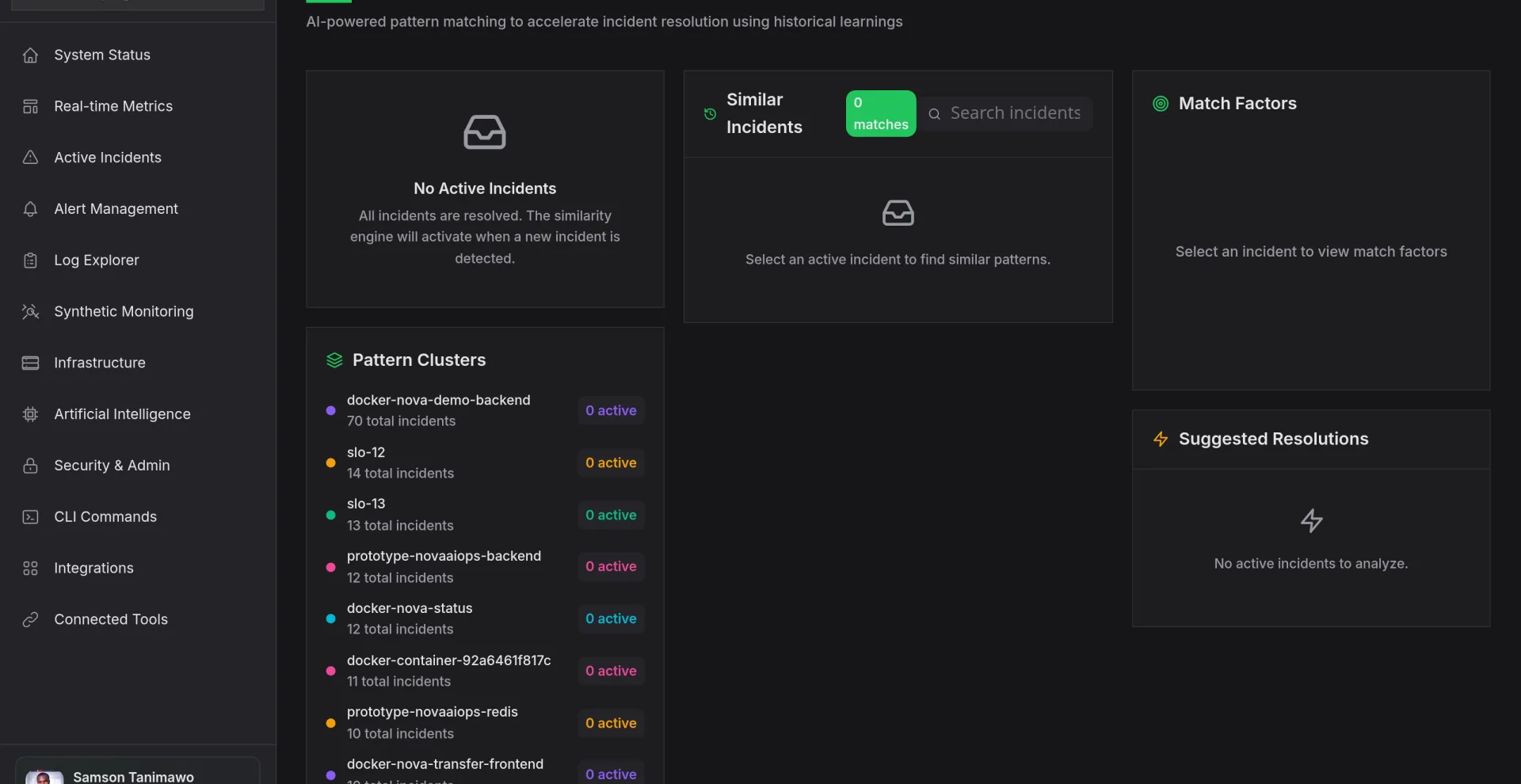
Vector-Based Pattern Matching
Every incident becomes a searchable fingerprint
Nova converts each incident into a high-dimensional vector that captures its signal patterns, affected services, error signatures, and resolution steps. When a new incident arrives, it is compared against every historical fingerprint in your library, not by keyword matching, but by structural similarity. A Redis connection timeout today matches the Redis connection timeout from six months ago even if the error messages use completely different wording.
- ✓
Multi-signal fingerprinting: incidents encoded from metrics, logs, traces, and topology data for deep structural comparison
- ✓
Sub-second retrieval: approximate nearest neighbor search across 10,000+ historical incidents completes in under 5 seconds
- ✓
Cross-environment matching: staging incidents match production patterns, catching issues before they hit customers